


Local SEO Isn't Dead: You're Just Doing It Wrong
Have you heard the rumors? Whispers in the marketing world are claiming that local search engine optimization (SEO) is a relic of the past. Maybe you’ve even thought it yourself after sinking time and effort into your online presence with little to show for it. If you’re feeling like you’re just spinning your wheels, we get it. But here’s the truth: local SEO isn’t dead. It’s more important than ever, but the game has changed. You’re likely just focusing on the wrong things. Let’s clear up the confusion and show you what actually works to get local customers calling.
Forget the Myths: Here's the Real Deal with Local Search
So, why do so many business owners think local SEO is an outdated strategy? The confusion is understandable. The digital landscape is constantly shifting. With the rise of social media marketing, complex algorithm updates from Google, and an endless stream of new “must-do” marketing tactics, it’s easy to believe that foundational strategies have become obsolete.
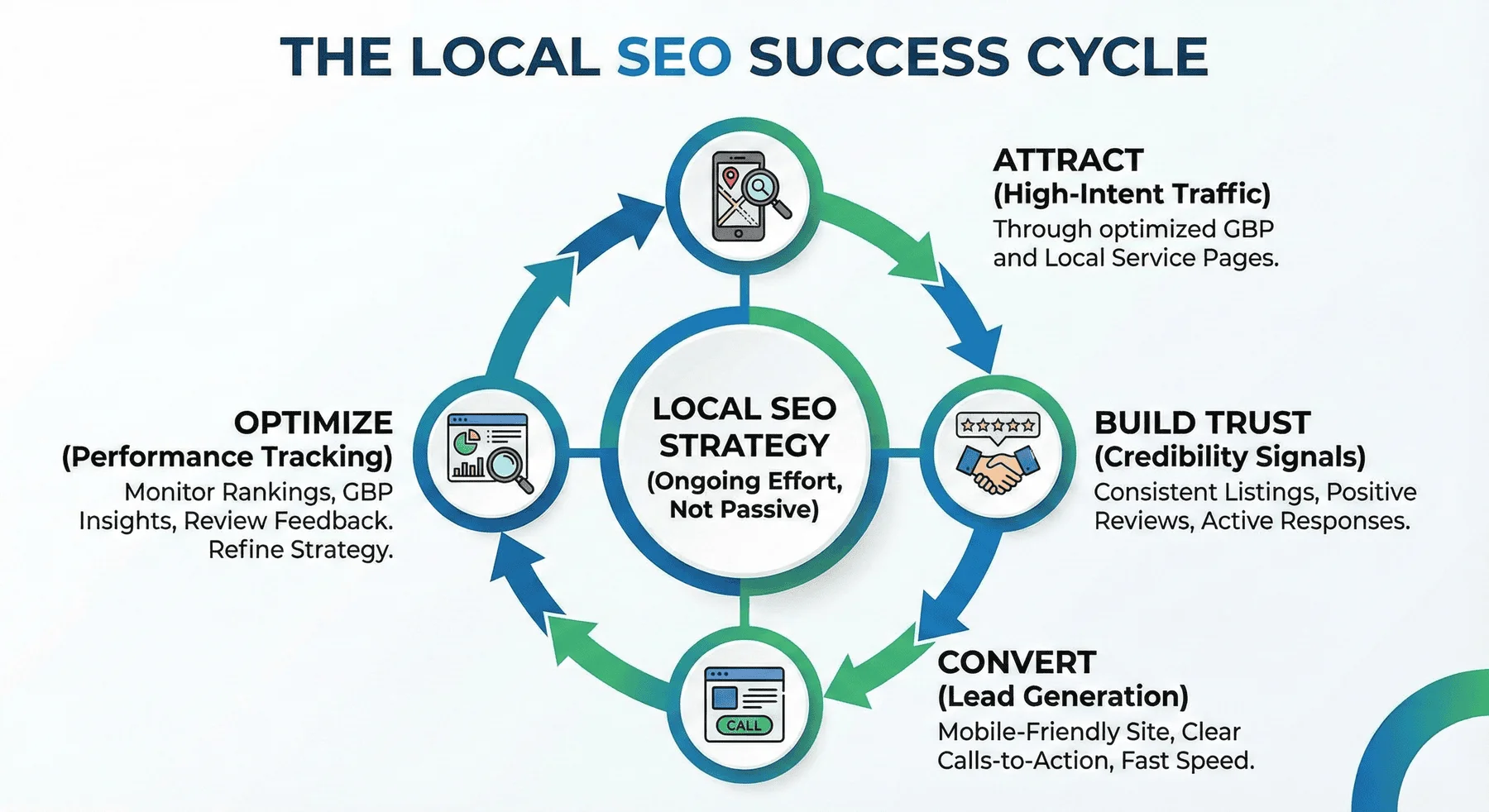
Many businesses make the mistake of treating local SEO as a one-and-done task. They set up a Google profile, maybe list their business in a few directories, and then expect the leads to roll in. When that doesn’t happen, they assume the strategy is flawed. The reality is, local SEO is not a passive activity. It’s an ongoing effort that requires consistent attention and a focus on the right signals. It’s not about trying to “trick” Google; it’s about proving you are a legitimate, active, and reputable local business.
The truth is that 97% of consumers use the internet to find local businesses, and 46% of all Google searches are seeking local information. If your business isn’t showing up in those searches, you’re essentially invisible to a massive portion of your potential customer base. The businesses that dominate local search results aren’t getting lucky; they’re executing a strategic, comprehensive approach that builds trust with both Google and potential customers.
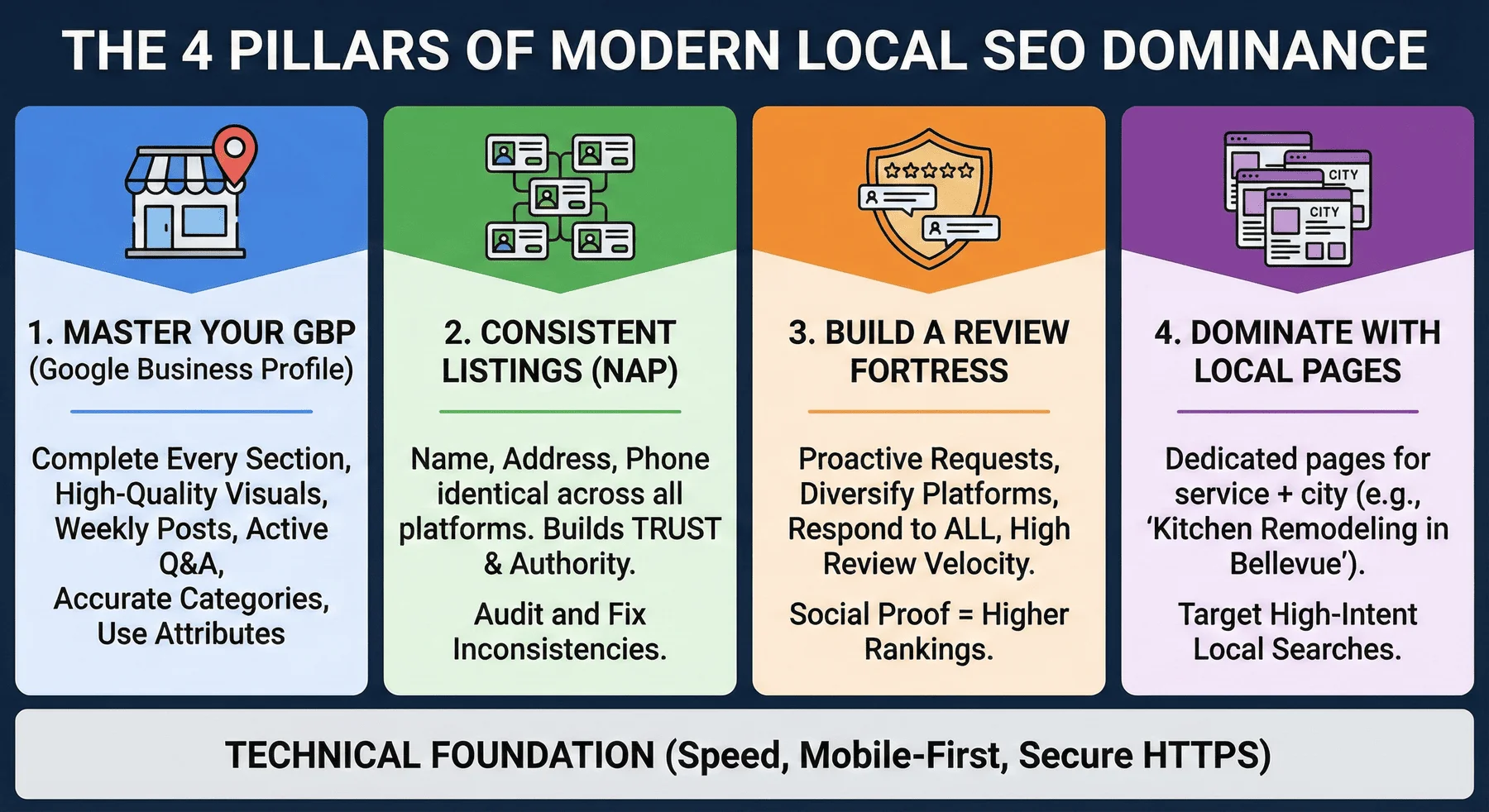
The Pillars of Modern Local SEO That Still Dominate
If you want to win in local search results, you need to stop chasing outdated tactics and focus on the four pillars that consistently deliver results. These are the strategies that tell Google you’re the best answer for a customer in your service area.
1. Master Your Google Business Profile
Your Google Business Profile (GBP) is the single most powerful tool in your local SEO arsenal. It’s often the first impression a potential customer has of your business, appearing in both Google Maps and the local search results. A half-finished or neglected profile is a huge red flag to both customers and search engines.
A fully optimized profile is a powerhouse for attracting local traffic. Here’s what that looks like:
- Complete Every Section: Don’t skip anything. Fill out your services, products, accessibility options, and business description with relevant keywords.
- Upload High-Quality Photos and Videos: Consistently add new photos of your work, your team, and your location. This shows you are an active business.
- Use Google Posts Weekly: Share updates, promotions, and recent projects through Google Posts. This is a direct signal to Google that your business is active.
- Encourage and Answer Q&As: Proactively populate the Questions & Answers section with common inquiries and provide thorough answers. Monitor and respond to new questions promptly.
- Select Accurate Categories: Choose the most specific primary category for your business, and add relevant secondary categories. This helps Google understand exactly what you do and when to show your business in search results.
- Add Attributes: Use attributes to highlight what makes your business unique—whether that’s “veteran-owned,” “women-led,” or specific services like “free estimates” or “emergency services available.”
Think of your Google Business Profile as your digital storefront. Just as you wouldn’t leave your physical location dirty or poorly maintained, you can’t afford to neglect this critical online asset. Businesses with complete GBP listings receive 7x more clicks than those with incomplete profiles.
2. Get Your Listings in Order (NAP Consistency)
NAP stands for Name, Address, and Phone Number. NAP consistency is the practice of ensuring this core information is identical across all online directories, social media profiles, and your website. It might sound trivial, but to Google, it’s a massive trust signal.
Think of it this way: if a dozen different sources list slightly different information for your business, how can Google be confident it’s showing a user the correct details? Inconsistencies create doubt. Consistent information, on the other hand, verifies your existence and location, which builds authority and boosts your local ranking. Take the time to audit your listings on platforms like Yelp, Bing Places, and industry-specific directories to ensure everything matches perfectly.
The challenge is that NAP information can spread across hundreds of directories, review sites, and data aggregators. Even small variations, like “Street” vs. “St.” or including a suite number in some listings but not others, can create confusion. A thorough citation audit should be one of your first steps in any local SEO campaign. Tools exist to help identify where your business is listed and where inconsistencies exist, but manual verification is often necessary to ensure accuracy.
Beyond just consistency, the quantity and quality of your citations matter too. Being listed on authoritative, industry-specific directories signals to Google that you’re a legitimate business in your field. For contractors and remodelers, this might include sites like Houzz, Angi, or HomeAdvisor. For therapists, it could be Psychology Today or GoodTherapy. The key is to prioritize directories that are relevant to your industry and trusted by both consumers and search engines.
3. Build a Fortress of Positive Reviews
Online reviews are the modern-day word-of-mouth. A steady stream of positive reviews is one of the most influential factors for both customers and local search rankings. In fact, 93% of consumers say online reviews influence their purchasing decisions, and businesses with higher review ratings and more reviews tend to rank higher in local search results.
However, a successful review strategy involves more than just collecting stars. You need to be proactive.
- Ask for Reviews: Don’t be shy. Ask your happy customers to leave a review. You can do this via email, text, or even in person. Make it easy by providing direct links to your Google Business Profile review page.
- Respond to All Reviews: This is critical. Thank customers for positive reviews and address negative feedback professionally. Responding shows you are engaged and care about customer satisfaction, which builds trust.
- Make It Part of Your Process: Integrate review requests into your customer journey. For service businesses, the best time to ask is right after project completion, when satisfaction is highest.
- Diversify Your Review Platforms: While Google reviews are crucial for local SEO, don’t neglect other platforms relevant to your industry. For remodelers, reviews on Houzz or Yelp can be valuable. For therapists, Psychology Today matters. Multiple review sources create a more comprehensive online reputation.
It’s also worth noting that review velocity, the rate at which you receive new reviews, matters to Google. A business that consistently earns new reviews appears more active and relevant than one with a static review count from years ago. This doesn’t mean you should artificially inflate your reviews (which violates Google’s policies and can result in penalties), but it does mean you should have an ongoing, systematic approach to earning authentic customer feedback.
4. Dominate with City and Service-Specific Pages
If you’re a contractor or service business, you likely work in multiple towns or neighborhoods. Are you telling Google that? A common mistake is having a single “Services” page that lists everything you do and everywhere you go. This dilutes your authority.
Instead, create dedicated pages on your website for your core services in your main service areas. For example, if you are a remodeler in Seattle, you should have pages like:
- “Kitchen Remodeling in Bellevue”
- “Bathroom Renovations in Kirkland”
- “Basement Finishing in Redmond”
These pages allow you to target specific, high-intent search queries (like “kitchen remodeler bellevue wa”). They signal to Google that you are a relevant authority for that service in that specific location, dramatically increasing your chances of showing up in local results for customers who are ready to buy.
Each location-specific page should include unique, valuable content, not just templated text with the city name swapped out. Include details about your experience in that specific area, local landmarks or neighborhoods you’ve worked in, and even testimonials from customers in that city. Add location-specific images of your work, and ensure each page has proper on-page SEO elements like optimized title tags, meta descriptions, and header tags that include both your service and location.
For businesses serving multiple cities across the Greater Seattle Area, from Kirkland and Bellevue to Tacoma and Spokane, this strategy can multiply your visibility exponentially. Each properly optimized location page becomes a new entry point for potential customers searching in that specific area.
The Technical Foundation You Can't Ignore
Beyond these four pillars, modern local SEO requires a solid technical foundation. Your website needs to load quickly, work flawlessly on mobile devices, and be secure (HTTPS). Page speed, in particular, has become increasingly important as Google prioritizes user experience. A slow-loading website not only frustrates potential customers but also sends negative signals to search engines.
Mobile responsiveness is non-negotiable. More than 60% of local searches now happen on mobile devices, and Google uses mobile-first indexing, meaning it primarily uses the mobile version of your site for ranking and indexing. If your website doesn’t provide an excellent mobile experience, you’re fighting an uphill battle in local search.
Schema markup, structured data that helps search engines understand your content, is another technical element that can give you an edge. Local business schema tells Google exactly what your business does, where you’re located, your hours of operation, and more. This information can appear in rich snippets in search results, making your listing more prominent and informative.
Conclusion
Local SEO is far from dead; it has simply evolved. The contractors and service companies dominating local search results aren’t using secret tricks. They are consistently executing the fundamentals: maintaining a perfectly optimized Google Business Profile, ensuring their business information is consistent everywhere, actively managing their online reviews, and building out targeted content for the specific areas they serve. By shifting your focus from outdated myths to these proven pillars, you can turn your website into a powerful magnet for local customers.
The businesses that succeed in local SEO understand that it’s a marathon, not a sprint. Results don’t happen overnight, but when you commit to a strategic, comprehensive approach, the payoff is substantial: a predictable pipeline of high-quality leads from customers actively searching for your services in your area.
Ready to Make Local SEO Work for You?
If you’re tired of guessing what works and are ready to implement a local SEO strategy that drives real, measurable results, we can help. Our team specializes in building powerful local search presences for contractors and service companies throughout the Greater Seattle Area. With our proven track record and transparent approach, we’ve helped businesses scale from $1M to $4M+ in annual revenue. Contact us today for a free, no-obligation consultation to see how we can help you dominate your local market.

About the author