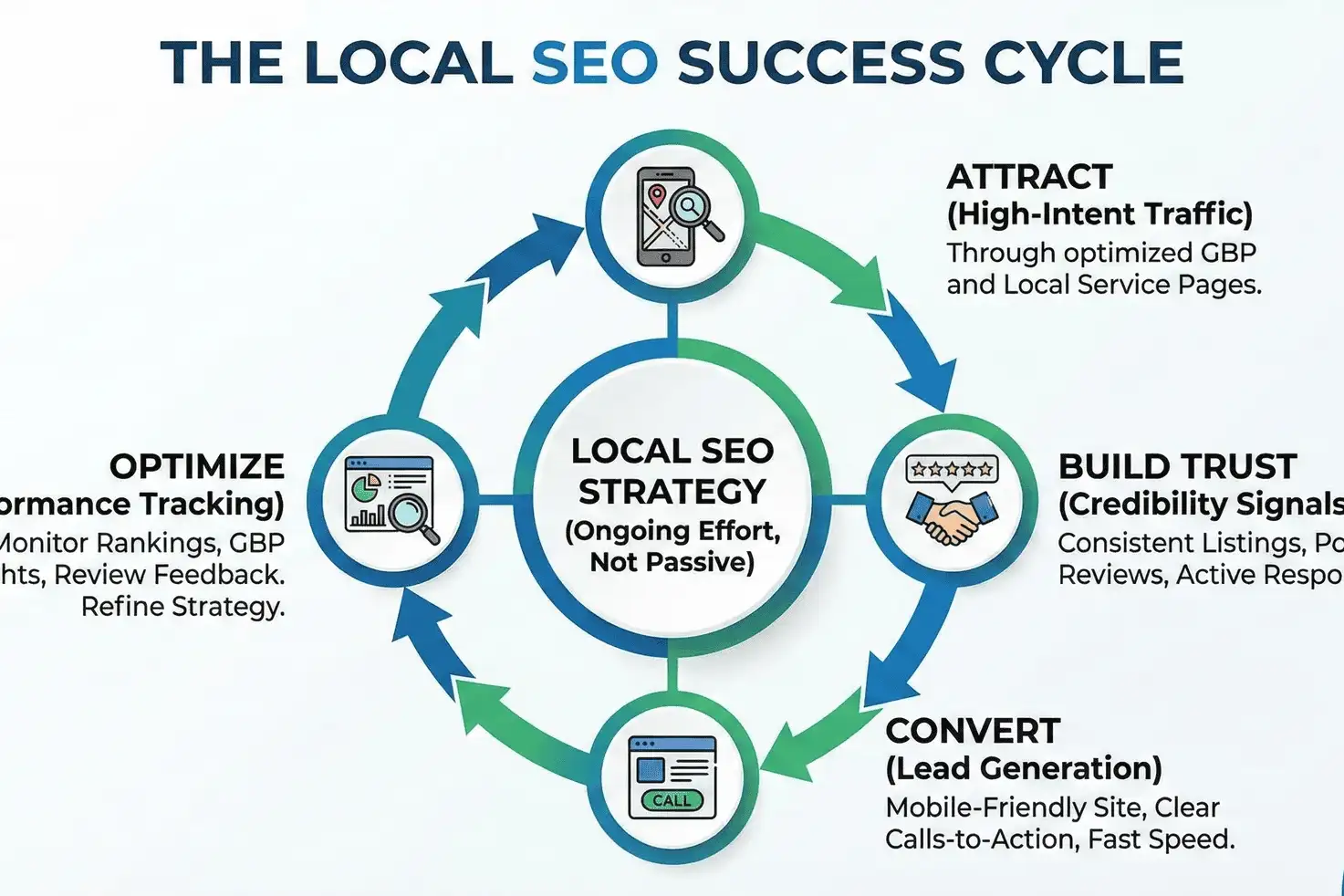

SEO vs Google Ads: Which Should a Local Business Invest in First?
Both drive leads. Both cost money. One builds over time, the other starts tomorrow. Here's how to decide which to invest in first based on your goals, budget, and timeline.

The Short Answer
If you need leads this week, start with Google Ads. If you can invest 3 to 6 months before expecting real return, start with SEO. If your budget allows it, run both from day one. That's what we recommend to most of our clients, and it's what we'd do if we were starting a local business ourselves.
But "it depends" is a frustrating answer when you're trying to make a real decision with real money. So let's get specific about what each channel actually does, what it costs, and when each one makes sense, based on what we've seen work across 100+ local business campaigns in the Seattle metro.
What Each Channel Actually Does
SEO (search engine optimization) improves your organic rankings in Google. When someone searches "plumber near me" or "best remodeler in Seattle" and your website shows up without a sponsored tag, that's SEO. You don't pay Google for those clicks. You earn them through content, technical optimization, and authority building. It's slower. It's harder to measure in week one. But when it kicks in, it's the most cost-effective lead source most local businesses will ever have.
Google Ads puts your business at the top of search results through paid advertising. You bid on keywords, write ads, and pay every time someone clicks. The moment you turn on a campaign, you're visible. The moment you turn it off, you disappear. It's that simple, and that expensive if you're not managing it well.

Think of it this way: Google Ads is renting space at the top of Google. SEO is buying property there. One gives you immediate access. The other builds equity over time.
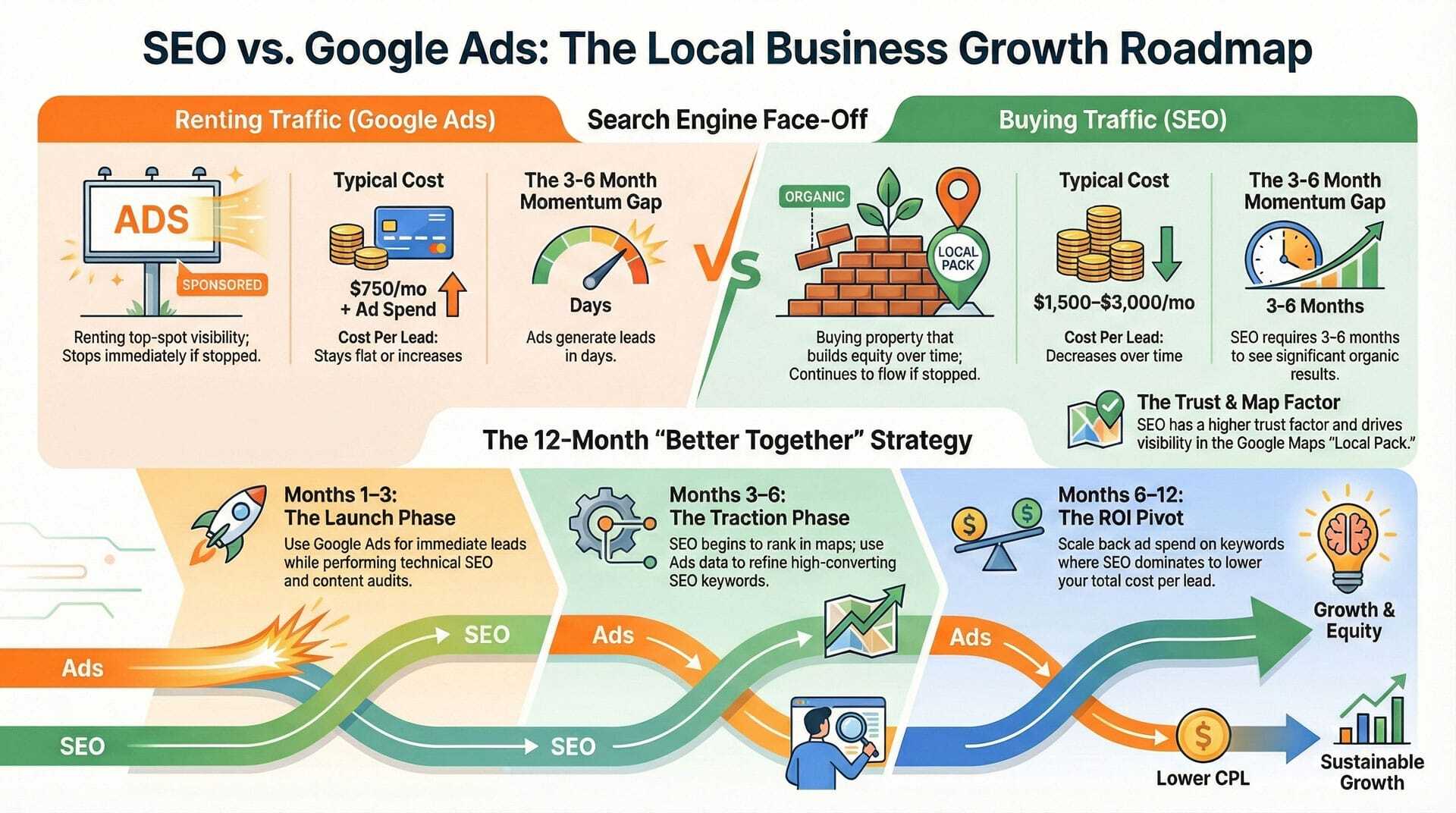
Side-by-Side Comparison
| SEO | Google Ads | |
|---|---|---|
| Time to results | 3–6 months | Days to weeks |
| Monthly cost | $1,500–$3,000/mo | $750/mo + ad spend |
| Traffic when you stop | Continues | Stops immediately |
| Cost per lead over time | Decreases | Stays flat or increases |
| Best for | Long-term growth | Immediate leads |
| Local pack (maps) | Strong impact | Limited impact |
| Competitive keywords | Takes time to rank | Instant visibility |
| Trust factor | Higher (organic) | Lower (labeled as ad) |
| Data & insights | Slower feedback loop | Immediate data |
When to Start With SEO
SEO is the right first move when you're building a business for the long term and you can wait a few months for momentum to build. It's especially powerful for local businesses because of Google's local pack, the map results that show up at the top of local searches.
SEO makes sense when:
Start With SEO If...
- You have steady cash flow and can invest for 3 to 6 months
- Your Google Business Profile needs optimization
- You want to reduce your cost per lead over time
- You're in a market where organic rankings are attainable
- You already have some word-of-mouth leads coming in
- You want your website to generate leads on its own
Start With Google Ads If...
- You need leads this month, not in 6 months
- You're launching a new business or entering a new market
- You have a specific budget for customer acquisition
- Your competitors dominate the organic results
- You want to test which keywords convert before investing in SEO
- You have seasonal demand you need to capture now
When to Start With Google Ads
Google Ads is the fastest path to leads. If you launched your business last month and need the phone to ring, this is where you start. There's no waiting period. You set a budget, target your keywords, and you're live.
The tradeoff is that every click costs money. A typical local service business might pay $8 to $35 per click depending on the industry. A plumber in Seattle might pay $25 per click. A therapist might pay $12. Those costs are real, and they don't go down over time the way SEO costs do relative to the traffic they produce.
But here's what Google Ads gives you that SEO can't: data, fast. Within the first 30 to 60 days, you'll know exactly which keywords drive calls, which ones waste money, and what your real cost per lead is. That intel is gold when you eventually invest in SEO because you're not guessing which keywords to target.

The Best Strategy: Run Both
The businesses that grow the fastest use both channels together. It's not SEO or Google Ads. It's SEO and Google Ads, phased strategically.
Here's how it typically works for our clients:
The compounding effect: The longer SEO runs, the lower your overall cost per lead becomes because organic traffic is essentially free after the initial investment. Google Ads costs stay relatively flat. Over 12 months, the business running both channels will almost always outperform the business running one.
Not Sure Where to Start?
We'll review your business, your competitors, and your market and tell you exactly where your marketing dollars will have the most impact.
How Your Industry Affects the Decision
The right mix depends heavily on what you do and who you're trying to reach.
Home services (contractors, roofers, plumbers, painters): These businesses tend to benefit most from starting with both. Google Ads captures high-intent searches like "emergency plumber Seattle" while SEO builds visibility for broader terms like "best plumber in Seattle" and local pack presence. The search volume is high and the leads are valuable, so investing in both channels early pays off fast.
Professional services (lawyers, therapists, accountants): SEO tends to be the stronger long-term play here because trust and credibility matter more. People research attorneys and therapists before making contact. Content marketing and strong organic presence build that trust. Google Ads works well for capturing immediate demand, but the real growth comes from ranking for informational and comparison keywords.
E-commerce and retail: Google Shopping ads are extremely effective for product-based businesses and should usually be part of the strategy from day one. SEO for e-commerce is a longer game but essential for category and product page visibility.
What About Your Website?
Here's the thing nobody wants to hear: neither SEO nor Google Ads will work well if your website can't convert visitors into leads. We see this constantly. Businesses spending $3,000 a month driving traffic to a site that loads slowly, looks outdated on mobile, or buries the phone number. You're basically paying to send people to a competitor.
Before you invest in either channel, make sure your site loads in under 3 seconds, works on every device, has clear calls to action above the fold, and makes it dead simple for someone to call or fill out a form. If your website is more than a few years old or was built by someone who wasn't thinking about conversions, fixing that first will multiply the return on everything else you do.
The Bottom Line
Stop thinking of this as SEO versus Google Ads. They're not competing strategies. They're two halves of the same system. Ads give you speed and data. SEO gives you compounding value and lower costs over time. The local businesses dominating search right now? Almost all of them are running both.
If you're forced to pick one, match the channel to your timeline. Need the phone to ring this month? Google Ads. Building something that lasts? SEO. Can swing both? That's the move.
SEO vs Google Ads FAQ
Let's Figure Out the Right Strategy for Your Business
We'll look at your market, your competitors, and your goals and tell you exactly where to invest. Free consultation, no obligation.
About the author