


The Hidden Costs of DIY Marketing (and What It Really Takes to Compete)
As a small business owner, you are the ultimate multitasker. You are the CEO, the head of sales, the customer service manager, and often, the chief marketing officer. The do-it-yourself spirit is likely what propelled you to start your own company.
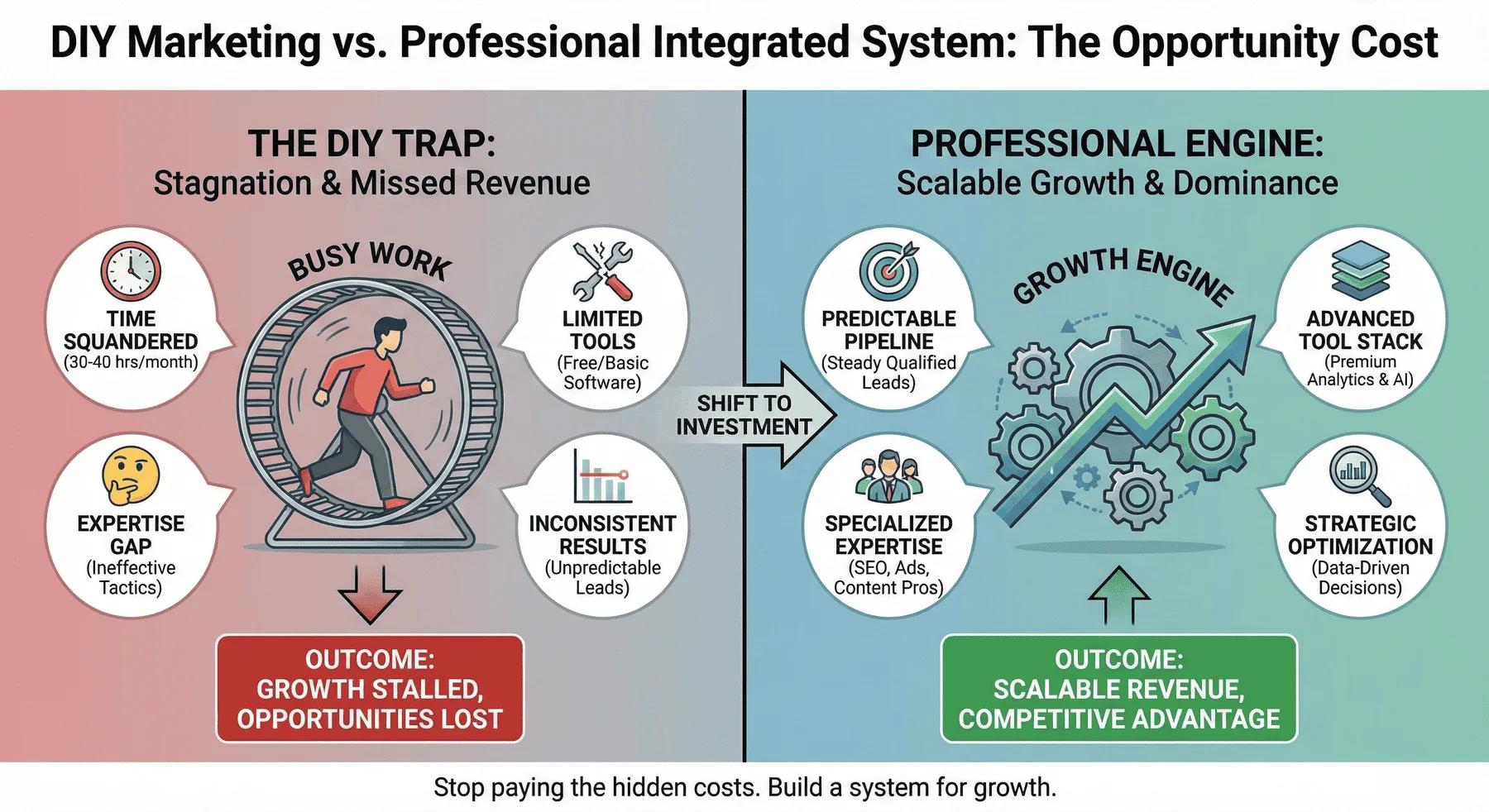
So, when it comes to marketing, it’s natural to think, “I can handle this myself and save some money.” On the surface, this logic is sound. Why pay someone else for something you can learn to do? But what if the real cost of DIY marketing isn’t measured in dollars saved, but in opportunities lost, time squandered, and growth stalled?
The “free” or “cheap” marketing you’re managing yourself comes with high hidden costs that are far more expensive than any agency fee. In this guide, we will pull back the curtain on the true price of DIY marketing. We’ll explore the pitfalls you may not see coming, calculate the actual value of your time, and outline what it genuinely takes to build a marketing engine that not only competes but dominates in today’s digital arena.
The Unseen Invoice: Calculating the Real Cost of Your Time
What is an hour of your time worth? It’s a question every business owner should be able to answer, but few calculate correctly. You might think of it as your salary divided by hours worked, but the true value is much higher. Your time is the most valuable asset your business has. Every hour you spend on a task is an hour you can’t spend on high-value activities like closing deals, refining your services, managing your team, or steering the strategic vision of your company.
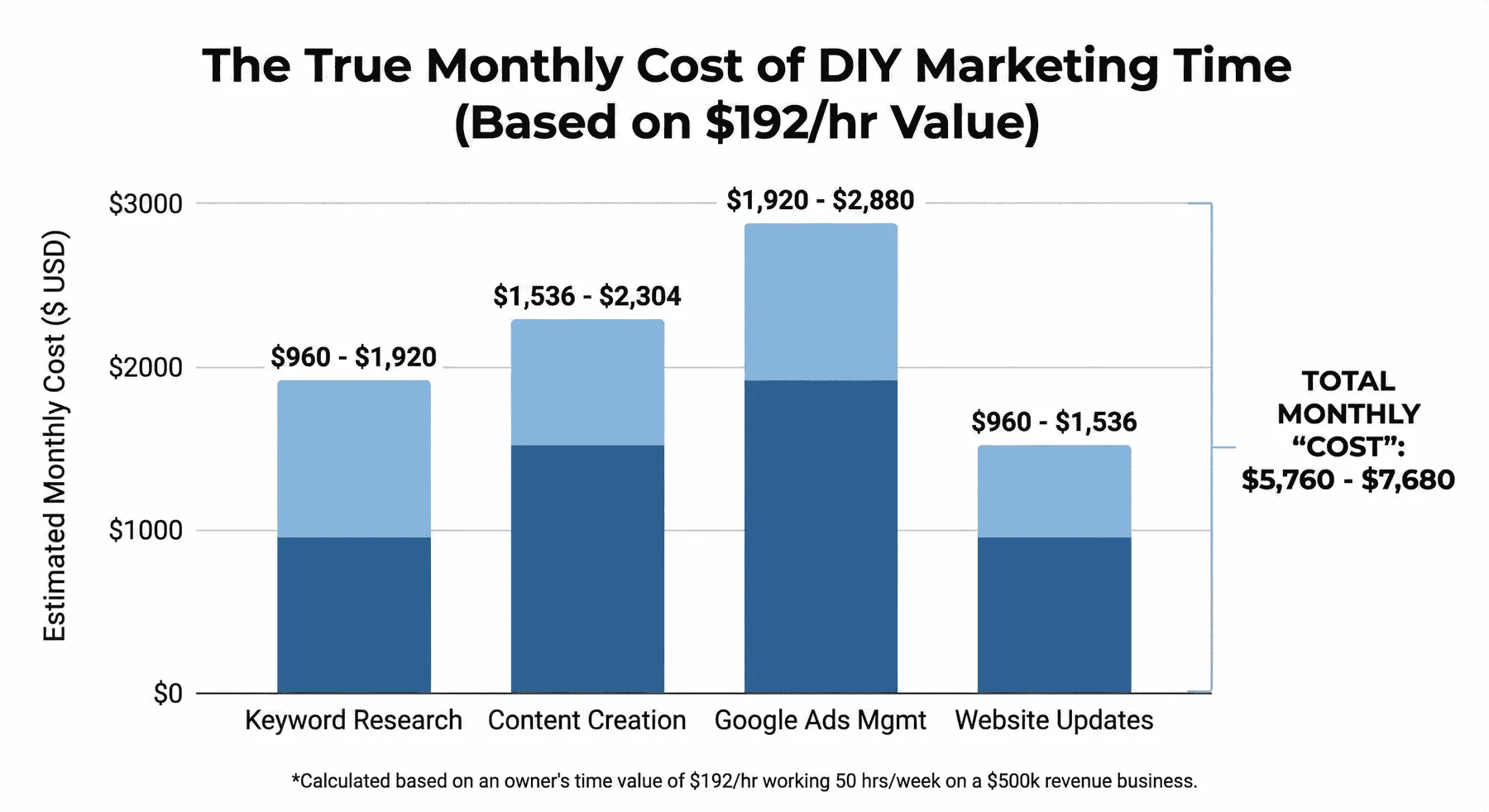
Let’s do some simple math. If your business generates $500,000 in annual revenue and you work 50 hours a week, your time generates roughly $192 per hour for the company. Now, consider the hours you spend on marketing:
- Keyword Research: Properly researching keywords, analyzing competitors, and understanding search intent isn’t a one-time task. A thorough job can take 5-10 hours per month.
- Content Creation: Writing one high-quality, SEO-optimized blog post or service page (at least 1,500-2,000 words) can take anywhere from 8 to 12 hours, from research and outlining to writing and editing.
- Google Ads Management: Setting up a campaign is just the beginning. Daily bid monitoring, A/B testing ad copy, analyzing performance data, and refining keyword lists can easily consume 10-15 hours per month.
- Website Updates: Keeping your WordPress site, plugins, and content fresh requires a few hours each month.
Suddenly, you’re spending 30-40 hours a month just on basic marketing tasks. At our calculated rate of $192/hour, you’re “spending” between $5,760 and $7,680 of your own high-value time on marketing. This isn’t a saving; it’s a massive expense. It’s time taken away from activities that only you, the owner, can do to drive real growth. The answer is obvious. The opportunity cost of DIY marketing is the first, and perhaps greatest, hidden expense.
The Expertise Gap: When "Good Enough" Is Dangerous
Modern digital marketing is not a field for generalists. It’s a complex ecosystem of interconnected disciplines, each requiring deep, specialized knowledge. Search engine algorithms change hundreds of times a year, ad platforms are in constant flux, and what worked six months ago might be actively harming your business today. Attempting to manage this without expert knowledge is like trying to do your own electrical work without being an electrician; you might get the lights to turn on, but you also might burn the house down.
The Intricacies of Search Engine Optimization (SEO)
Getting your website to rank on Google is far more complex than just sprinkling in a few keywords. Today’s SEO is a multi-faceted discipline.
- Strategic Keyword Research: Professionals don’t just find keywords; they analyze user intent. Is someone searching for “kitchen remodel ideas” (informational intent) or “kitchen remodelers in Bellevue” (transactional intent)? Targeting the wrong intent wastes time and attracts a worthless audience.
- Content that Builds Authority: Google’s E-E-A-T guidelines (Experience, Expertise, Authoritativeness, and Trustworthiness) mean that thin, generic content doesn’t rank. You need in-depth, expert-level content that genuinely helps the user. For a high-end contractor, this means detailed project pages, guides on material selection, and articles that showcase your deep industry knowledge.
- Technical SEO: Is your site mobile-friendly? Does it load in under three seconds? Have you implemented schema markup to help Google understand your services? These technical factors are non-negotiable ranking signals that a DIY approach often overlooks.
A common DIY mistake is creating content that is either over-optimized and unreadable or too generic to be valuable. The result? Your site gets ignored by both users and search engines, or worse, penalized for “black-hat” tactics you didn’t even know you were using.
The Financial Black Hole of Google Ads
Google Ads can be an incredible tool for generating immediate leads, but for the inexperienced, it’s one of the fastest ways to burn through cash with nothing to show for it.
- The Auction and Quality Score: Your ad’s position isn’t just about the highest bid. Google’s Quality Score, a metric based on ad relevance, landing page experience, and expected click-through rate, heavily influences your cost-per-click and placement. A low Quality Score means you pay more for worse positions.
- Negative Keywords: Are you a luxury remodeler getting clicks from people searching for “cheap DIY kitchen cabinets”? Without a robust list of negative keywords, you’re paying for irrelevant traffic that will never convert.
- Conversion Tracking: If you can’t accurately track which clicks are turning into phone calls and form submissions, you’re flying blind. You have no way of knowing what’s working, so you can’t optimize your budget.
An expert Google Ads manager, especially one with experience in your industry, like the trades, knows how to structure campaigns, write compelling ad copy, and optimize for conversions. They can turn a $1,000 ad spend into $10,000 of revenue, while a DIY approach often turns that same $1,000 into a sunk cost.
The Price of Admission: The Professional Tool Stack
Another major hidden cost is the software and tools required to execute marketing at a professional level. The “free” tools you find online are often severely limited and don’t provide the data needed to make strategic decisions. A professional marketing agency invests heavily in a sophisticated tool stack.
Here’s a glimpse of what that looks like and its approximate monthly cost:
- Advanced SEO Platforms (e.g., SEMrush, Ahrefs): These are essential for comprehensive keyword research, competitor analysis, backlink tracking, and site audits. Cost: $200 – $500+ per month.
- Call Tracking and Analytics (e.g., CallRail): To know which marketing channels are driving phone calls, you need a dedicated call tracking service. Cost: $50 – $150+ per month.
- CRM and Email Marketing Software (e.g., HubSpot, ActiveCampaign): For nurturing leads and managing customer relationships. Cost: $100 – $400+ per month.
- Design and Visual Content Tools (e.g., Adobe Creative Suite, Canva for Teams): For creating professional graphics, ads, and social media content. Cost: $50 – $100+ per month.
- Reporting and Dashboard Tools (e.g., Google Data Studio connectors, Supermetrics): To aggregate data from different sources into a single, easy-to-understand report. Cost: $50 – $200+ per month.
When you add it all up, the “price of admission” to do marketing properly can easily exceed $500 to $1,000 per month, and that’s before you’ve spent a single dollar on ad campaigns. When you partner with an agency, you gain the benefit of their entire tool stack, which is included in your management fee. This alone can make outsourcing a more cost-effective option.
The Real Loss: Stagnation and Missed Opportunities
Perhaps the most damaging hidden cost of DIY marketing is the opportunity cost. It’s not just about the time and money you’re spending; it’s about the growth you’re not achieving. While you’re busy learning the basics of SEO, your competitor who hired an expert is already on page one, capturing leads that should have been yours. While you’re trying to figure out Google Ads, they’re enjoying a predictable pipeline of high-value clients.
A strategic marketing partner doesn’t just execute tasks; they build a system for growth. This system is designed to:
- Create a Predictable Lead Pipeline: Instead of relying on inconsistent referrals, you get a steady stream of qualified inquiries from your website and ad campaigns.
- Attract Higher-Value Clients: A professional online presence and targeted marketing attract clients who are looking for quality and expertise, not just the lowest price. This is how remodelers in competitive markets like Seattle move from small jobs to six-figure whole-home renovations.
- Enable Scalable Growth: A well-oiled marketing machine is the engine that powers a business from $1M to $4M+ in annual revenue. It provides the consistent demand needed to justify hiring more staff and taking on larger projects.
- Leverage Advanced Technology: At Integrity, we built our own proprietary SEO engine, April AI, which delivers 38% stronger rankings while cutting production time. This is the kind of competitive advantage that is impossible to replicate with a DIY approach.
By trying to save a few thousand dollars a month, you could be forfeiting tens or even hundreds of thousands of dollars in new business over the course of a year. That is the true, devastating cost of DIY marketing.
What It Really Takes to Compete: An Integrated System
Competing in today’s market is about more than just having a website or running a few ads. It requires an integrated, strategic system where every component works together to drive results.
- A Conversion-Focused Website: Your website is the hub of your digital presence. It must be professionally designed, lightning-fast, mobile-friendly, and built to convert visitors into leads. A simple brochure site is no longer enough.
- A Data-Driven SEO Strategy: This is your long-term engine for organic growth. It involves ongoing technical optimization, building local authority, and consistently publishing high-value content that establishes you as an expert and answers your customers’ questions.
- Precision-Targeted Paid Advertising: Google Ads provides the immediate leads needed to fuel your business while your SEO gains momentum. A professional campaign targets the right people with the right message at the exact moment they are ready to buy.
- Constant Analysis and Optimization: Marketing is not a “set it and forget it” activity. It requires constant monitoring of data, analyzing what’s working, and making strategic adjustments to maximize your return on investment.
Building and managing this kind of integrated system is a full-time job that requires a team of specialists. It’s what we do every day for businesses in the trades, healthcare, legal, and e-commerce sectors.
Conclusion: Shifting from an Expense to an Investment
The temptation to manage your own marketing is understandable, but it’s a decision based on a false economy. When you account for the value of your time, the steep learning curve, the cost of professional tools, and the massive opportunity cost of slow growth, DIY marketing is revealed to be incredibly expensive.
Outsourcing your marketing to a strategic partner is not an expense; it is an investment in a predictable, scalable system for growth. It frees you to do what you do best: run your business. By putting your marketing in the hands of experts, you’re not just buying services; you’re buying back your time, leveraging deep expertise, and building a competitive advantage that will pay dividends for years to come.
Stop Paying the Hidden Costs of DIY
If you’re tired of spinning your wheels and are ready to see what a professional, integrated marketing strategy can do for your business, it might be time for a conversation. Contact Integrity Marketing today for a free consultation. Let’s analyze what you’re currently doing, identify the hidden costs, and map out a clear path to real, measurable growth.

About the author